AI-generated note
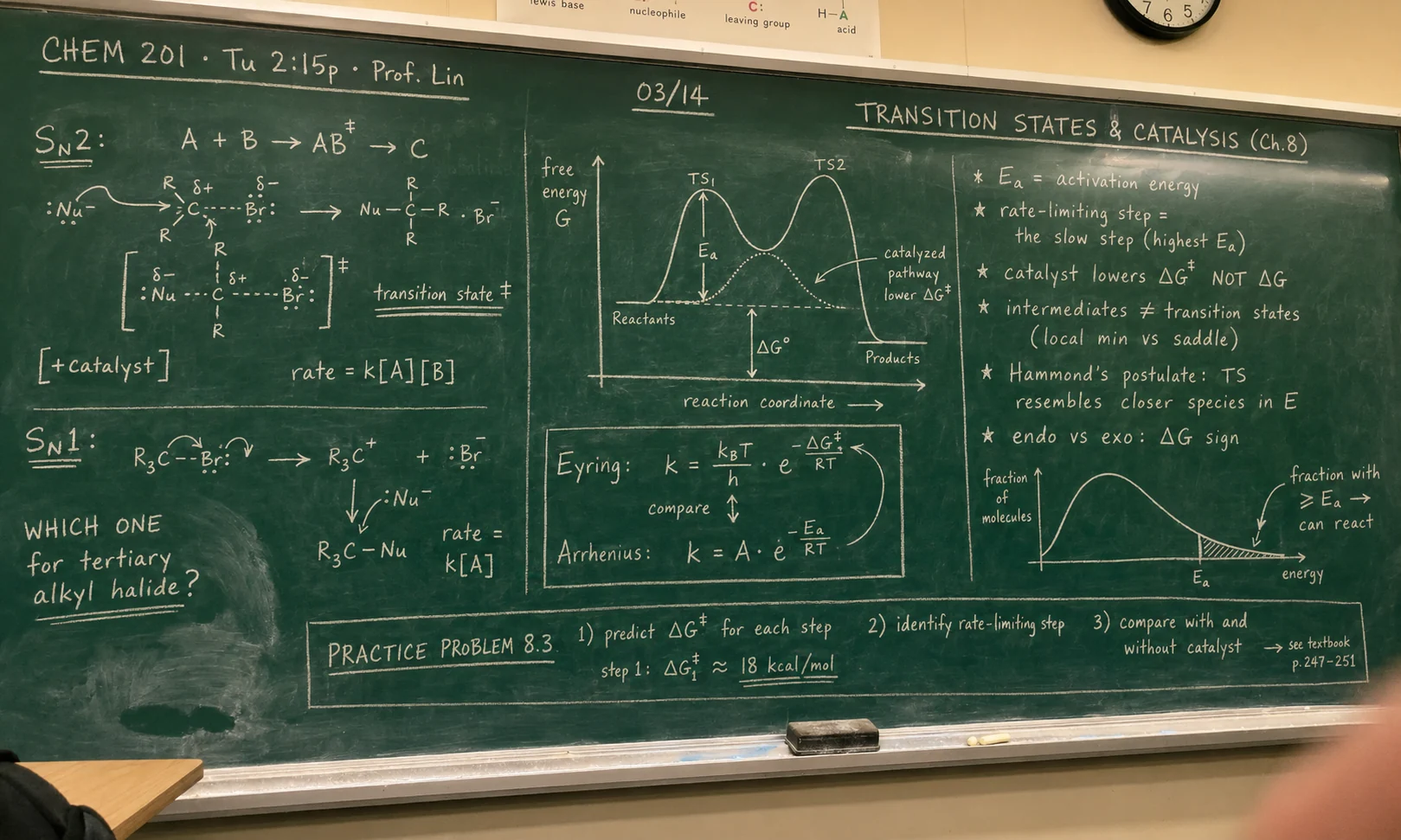
Transition states & catalysis — lecture notes
Source: Chemistry whiteboard photo · CHEM 201 · Tu 2:15p · 23 labels detected
Chapter context
Board- Course: CHEM 201 · Prof. Lin · Tu 2:15p · 03/14.
- Topic banner: Transition States & Catalysis (Ch. 8).
- Why it matters: Sets the conceptual frame for everything in kinetics this term.
- Reading: Textbook §8.4–§8.9, p. 247–251.
- Exam relevance: Two midterm questions historically come from this material.
SN2 mechanism
Board- Reaction: A + B → AB‡ → C — concerted, single-step.
- Transition state: AB‡ is a saddle point where bond-making and bond-breaking happen simultaneously.
- Stereochemistry: backside attack causes Walden inversion of configuration at the C centre.
- Rate law: rate = k[A][B] — second order, depends on both substrate and nucleophile.
- Partial charges: δ⁺ / δ⁻ on the carbon and leaving group highlight the developing dipole in the TS.
SN1 mechanism
Board- Two steps: R₃C—Br ionises to a carbocation R₃C⁺ + Br⁻, then nucleophile attacks: R₃C⁺ + :Nu⁻ → R₃C—Nu.
- Intermediate: the carbocation is a real species (local minimum) — distinct from a transition state.
- Rate law: rate = k[A] — first order, only depends on the substrate.
- Stereochemistry: the planar carbocation can be attacked from either face → racemization.
- Board question answered: for a tertiary alkyl halide, SN1 dominates — steric crowding blocks SN2 backside attack and bulky R groups stabilise the carbocation.
Energy diagram
Board- Axes: x = reaction coordinate, y = free energy G.
- TS1 and TS2: two peaks on a multi-step pathway; reactants and products sit in energy wells.
- ΔG°: standard free-energy change of the overall reaction (products − reactants).
- ΔG‡: free-energy of activation: height of each barrier from preceding minimum.
- Catalysed path: dotted lower curve — same products and same ΔG°, but lower ΔG‡.
Activation energy & rate
Board- E_a: activation energy = the barrier the reactants must overcome to reach the TS.
- Rate-limiting step: in a multi-step mechanism, the slow step is whichever has the highest E_a — it sets the overall rate.
- Temperature effect: raising T shifts the Boltzmann distribution so more molecules have ≥ E_a → reaction speeds up.
- Catalyst rule: lowers ΔG‡ via an alternative pathway. Does NOT change ΔG, K_eq, or product distribution.
Eyring vs Arrhenius
Board- Eyring: k = (k_BT/h)·e^(−ΔG‡/RT) — thermodynamic form, uses free energy of activation.
- Arrhenius: k = A·e^(−E_a/RT) — empirical, A = pre-exponential factor (attempts/sec).
- Decomposition: ΔG‡ = ΔH‡ − TΔS‡; Eyring exposes entropy of activation, Arrhenius does not.
- Both predict: rate constant grows exponentially with temperature.
Key definitions
Board- Intermediate ≠ TS: intermediate = local energy minimum, has measurable lifetime. TS = saddle point, no lifetime.
- Hammond's postulate: the TS structurally resembles whichever species (reactant or product) it is closer to in energy.
- Endo vs exo: sign of ΔG: exergonic (ΔG < 0) is product-favoured; endergonic is reactant-favoured.
- Catalyst caveat: alters mechanism only — equilibrium constant K and ΔG remain unchanged.
Practice problem 8.3
Board- Task 1: predict ΔG‡ for each step of a given multi-step mechanism.
- Task 2: identify the rate-limiting step (highest ΔG‡).
- Task 3: compare the energy profile with and without a catalyst.
- Worked step 1: ΔG‡_1 ≈ 18 kcal/mol — set this as the bar to beat for the catalysed path.
- Reading: see textbook p. 247–251 for two more worked examples.